Boredom, Suffering, and the Formation of Resilience

Introduction
I’ve watched it happen over and over again—children given everything, entertained constantly, protected from discomfort, and praised for every little thing. And yet somehow, we end up with a generation that is more anxious, more fragile, and more disoriented than ever.
The more I’ve reflected on this—not only as a pastor and teacher but also as someone shaped by struggle—the more convinced I am that our cultural obsession with comfort is doing real harm. We’ve confused love with protection from pain, when in reality, love sometimes allows struggle because it knows what struggle can produce.
This article is both personal and theological. It’s a reflection on how early discomfort, struggle, and even childhood anxiety helped form my emotional maturity—and how I believe God is calling us, as parents, mentors, and leaders, to raise a generation that can not only be taught about suffering—but actually catch what it means to suffer well, to endure faithfully, and to grow through it.
Formed by Discomfort
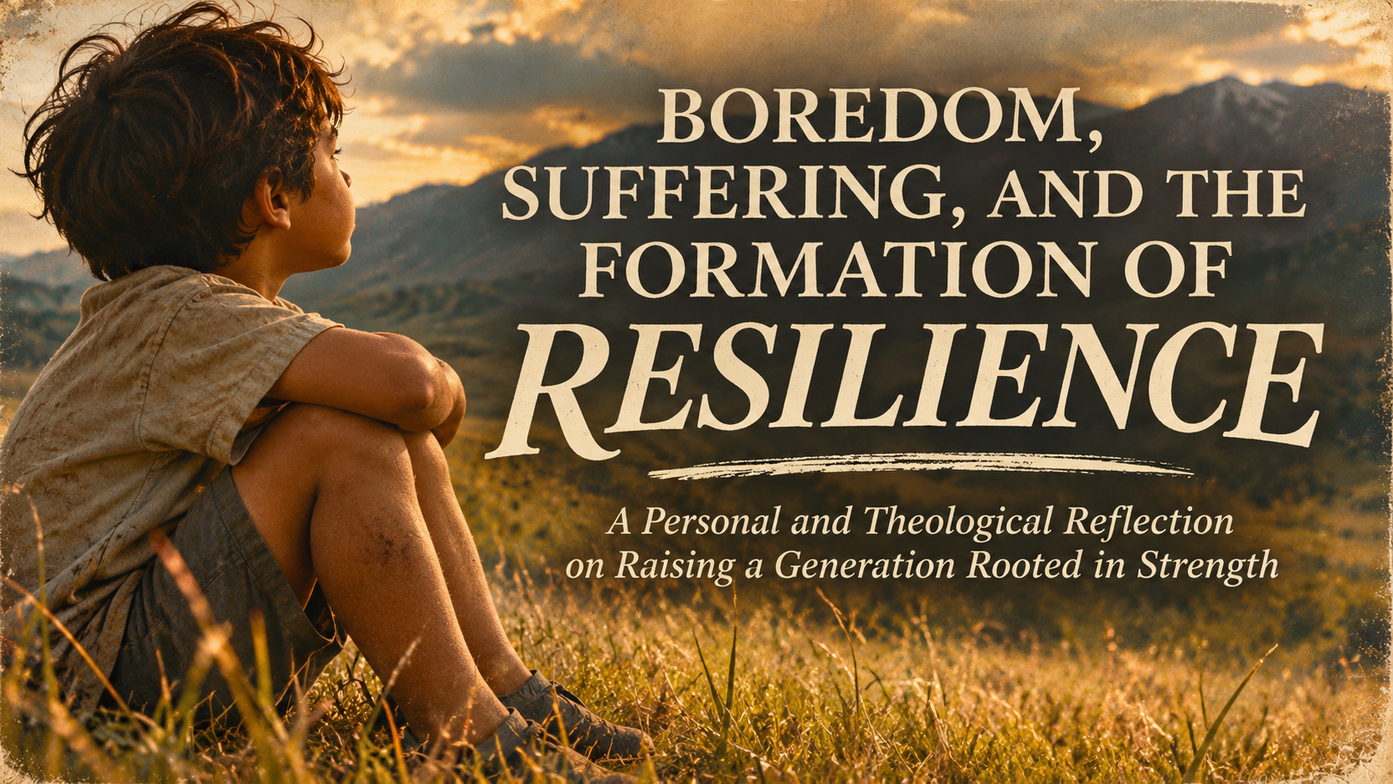
I remember being bored as a child. Not just “nothing to do” bored—but the kind that makes you wrestle with yourself. As Millennials, many of us spent hours outside, inventing games or lying in the grass with nothing but our imaginations. When I told my mom I was bored, she’d say, “Go outside—but be back before the streetlights turn on.”
What I didn’t know at the time is that this space—this lack of stimulation—was doing something in me. Neuroscience now tells us that boredom activates the brain’s “default mode network,” which supports creativity, introspection, and problem-solving. In other words, learning to sit in discomfort develops the same parts of the brain we need to navigate adulthood.
Today, many children never get that chance. Screens are introduced far too early—often before age two—disrupting healthy cognitive development and emotional resilience. When we constantly pacify children with pleasure, we prevent them from developing the inner structure needed to endure hardship later in life.
Although it felt like suffering at the time, I now see that boredom was an early invitation to develop patience, imagination, and inner strength. Suffering, even in its smallest forms, doesn’t need to be explained—it needs to be experienced, modeled, and then reinforced with wisdom. It needs to be caught.
Endurance Starts Early
There’s a controversial idea in parenting called “letting your child cry it out.” I know people are split on it, but hear me out. We’re not talking about abandonment—we’re talking about allowing children, at age-appropriate moments, to begin learning how to self-soothe and regulate their emotions.
Even as babies, we begin the process of discovering that we can experience distress and still be okay. Studies have shown that structured sleep training—where crying is permitted in measured intervals—helps infants sleep better and develop emotional regulation without causing long-term harm.
Why does this matter? Because many of us are raising children who are emotionally unequipped. They grow up never having practiced resilience, never learning how to move through sadness, frustration, or fear. We protect them from the process of pain, and then wonder why they break under pressure.
Emotional fragility doesn’t begin in adulthood—it’s planted in childhood when we teach that discomfort must always be avoided. But like anything meaningful in life, resilience is learned by experience—and caught by watching others live it.
Anxiety and Early Formation
I was raised by a single mother. She was strong, focused, and determined to raise children who could stand on their own two feet. When I wanted something, she didn’t hand me the answer. She challenged me to figure it out for myself.
I remember the anxiety that caused in me as a child. I didn’t always feel safe. I didn’t always feel certain. But I can now say it was one of the most formative gifts I ever received.
That anxiety taught me something crucial: how to wrestle with emotion. How to problem-solve. How to endure tension without collapsing. What I’ve seen in others—and sometimes even in myself—is that when we don’t encounter these kinds of struggles early, we grow up thinking something’s wrong with us the first time life gets heavy. But we’re not broken—we’re simply using muscles no one helped us develop.
If no one ever told you: it’s okay to feel anxious. You’re not disqualified. You’re developing.
I had a friend in Bible college who later became a pastor. But he struggled silently with deep anxiety. He didn’t think pastors were allowed to feel that way. He thought that if he had emotional pain, it meant his faith was defective. That lie led him into depression. What he didn’t know—and what I wish I could’ve told him—is that pastors struggle too. Sanctification doesn’t erase weakness—it redeems it.
And maybe you're realizing this now, in adulthood: you don’t always get your way. People disappoint you. Emotions show up you never had to face before. It’s overwhelming. But it’s not the end—it’s a beginning. Emotional maturity doesn’t come with age; it comes with practice. And it’s never too late to start.
Just like a child learns to name their emotions, adults can learn too. Start by identifying what you feel. Give yourself space to sit in it without fixing it. Invite someone safe into the process. Let the Holy Spirit guide the work. You don’t have to walk it alone—but you do have to walk it.
Suffering is caught not only by observing others—but by entering into our own and letting God meet us there.
Becoming Like Christ Through Suffering
One of the most liberating truths I’ve discovered in my walk with Christ is this: suffering isn’t failure. It’s formation.
Hebrews five says that Jesus learned obedience through what He suffered. Isaiah fifty-three tells us that He was a man of sorrows, acquainted with grief. The Savior we follow didn’t avoid pain—He entered it, and in doing so, transformed it into redemption.
It is only through the Holy Spirit and through dying to our old mindsets and habits that we can break off the strongholds of emotional immaturity, indulgence, and comfort addiction. Embracing suffering as a tool is not cruel—it is Christlike.
I’ve come to realize that I am not the best version of myself—and that’s okay. I am justified in Christ, and I am working out my salvation with fear and trembling. Sanctification isn’t about appearing holy—it’s about becoming real. Becoming like Him.
When we embrace the hard work, the boredom, the silence, the correction—we stop chasing indulgence and begin pursuing transformation. And the Holy Spirit becomes not just our comforter—but our refiner.
Suffering Together: Why Koinonia Is Essential
We are not meant to do this alone.
Sanctification is deeply personal, but never private. Scripture calls us to koinonia—the kind of fellowship where we share not just meals or prayers, but suffering. Encouragement. Burdens. Growth.
Isolation in suffering breeds shame. But suffering in community births strength.
When someone says, “Me too,” or when someone quietly stays present through your pain, that’s when suffering stops being a source of isolation and starts becoming a space for transformation.
We need others who will hold us up when we’re weary. We need safe spaces to be honest without being dismissed. We need the kind of people who will lock arms with us, speak truth over us, and remind us that we’re not alone in this process.
Wholeness comes not just through personal prayer, but through shared life.
Conclusion: Raising a Generation That Can Stand—And Becoming That Generation Ourselves
If we want to raise children—and become adults—who are strong, wise, and grounded, we need to reclaim the value of suffering. We must resist the lie that comfort is the goal and begin to see hardship as part of our formation.
So if you're a parent, let your children wrestle. Let them feel the weight of “no.” Walk with them, but don’t erase their discomfort. Teach them that their emotions are real—and that they can survive them.
And if you’re an adult facing anxiety, pressure, or emotional fragility—you’re not broken. You’re in process. You’re not disqualified. You’re becoming.
Let’s normalize suffering—not because we celebrate pain, but because we believe in what God does with it. The cross wasn’t comfortable—but it was the pathway to redemption.
In Christ, suffering becomes sacred. It becomes the place where we are not only comforted—but transformed. Where we don’t just survive—but grow.
So let suffering do its work. Let discomfort form something lasting. And let it drive us together to the feet of Jesus.
Because that’s where healing begins.
And that’s where wholeness is caught.