The Stranger Things of God’s Truth About Evil

Introduction
Evil has always been something humanity struggles to understand. Across history, people have asked the same questions: Why does evil exist? Where does it come from? Why does it persist? These questions show up in philosophy, psychology, science, and theology—but they also show up in the imagination. When people tell stories, especially fictional ones, they often reveal how they are trying to make sense of the world, even when they are not attempting to explain reality in any formal way.
Fiction is not theology, and it does not claim to be Scripture. Stories like Stranger Things are creative works, not spiritual explanations. Still, fictional worlds often reflect the assumptions a culture carries about good and evil, suffering and hope. Stories do not define truth, but they can expose how people are trying to understand it.
The issue, then, is not storytelling itself. The issue is explanation. Scripture is clear about what evil is, where it comes from, and how it is ultimately dealt with. Human explanations—whether philosophical, psychological, or imaginative—can touch real aspects of evil, yet remain incomplete when God is left out of the picture. Half-truths can feel meaningful, but half-truths are still untruths. What follows is a reflection on how humans try to explain evil, how those attempts surface even in fiction, and why God’s truth brings clarity where our explanations fall short.
Body
I first began thinking deeply about this in a seminary class on psychology and spiritual formation. One day, my professor introduced Plato’s allegory of the cave. In the story, people are chained inside a cave, watching shadows on a wall. Because those shadows are all they have ever known, they believe the shadows are reality. Plato’s point was not to criticize imagination or inquiry, but to show how easily limited perception can be mistaken for truth.
That image stayed with me because it captures something deeply human. Often, we are confident in our understanding simply because what we see feels convincing.
My professor applied this idea to his understanding of evil. He believed in God but did not believe demons existed in a literal sense. He understood the language of Scripture as ancient ways of describing internal struggles—fear, trauma, and psychological distress—because people at the time lacked modern categories. I disagreed with him. Scripture speaks clearly about spiritual realities, and through pastoral ministry I have seen evidence that cannot be reduced to psychology alone. Still, I understood why his explanation resonated. Psychology explains real pain and real behavior. It just does not explain everything. It was thoughtful—but incomplete.
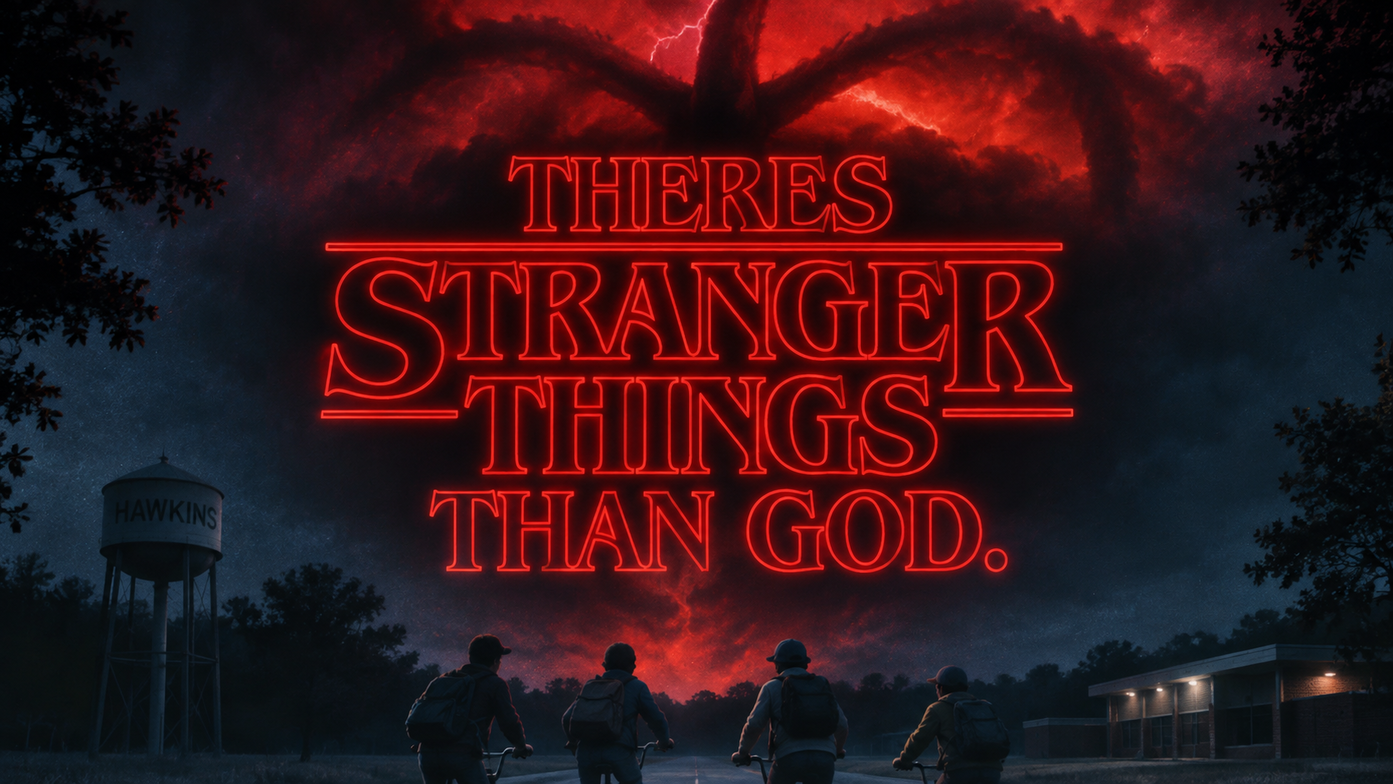
Years later, while watching season four of Stranger Things, that conversation came back to mind. The darkness portrayed in the show did not resemble what Scripture describes as demonic activity. That observation is not meant to deny spiritual realities or critique the show. What stood out instead was how human the darkness felt. The story imagines evil forming through pain, belief, power, and broken relationships—an attempt to visualize evil primarily through the human experience.
This is where Stranger Things, like many modern stories, reflects a half-truth. It recognizes that evil exists. It shows how darkness spreads. It portrays the damage caused by suffering and isolation. But God is absent from both the explanation and the solution. The story does not claim this absence is true; it simply mirrors how people often imagine evil when trying to understand it without reference to God.
As the narrative develops—especially in later seasons—the focus increasingly shifts toward human effort as the means of overcoming evil. Courage, unity, and determination become the hope. Again, this is not an attack on the story. It reflects something broader in society: the belief that humanity, working together, can ultimately overcome evil on its own. The danger is subtle. Evil is not denied; the way it is understood is reshaped.
This kind of thinking becomes dangerous because it changes how evil is judged. When evil is explained only through belief or experience, it can begin to justify itself. Darkness no longer looks clearly wrong—it looks complicated, understandable, even reasonable. Without Jesus and the Holy Spirit, discernment becomes difficult because truth is filtered only through human perspective.
Scripture teaches that human beings are made in the image of God, which means we have the ability to create. That ability is powerful, but it is not neutral. When creativity is aligned with God, it produces life, beauty, and goodness. When it is separated from Him, it can produce corruption and harm. One professor once remarked that demons do not create—humans do. Whether one fully agrees with that statement or not, it points to a reality we cannot ignore: humanity does not need supernatural involvement to generate great evil.
This tension shows up repeatedly in how people try to explain evil. Some explanations focus almost entirely on what happens inside us—our wounds, fears, and psychology—while others look only at influences outside of us. Each notices something real, but when separated, both fall short. Evil is rarely understood fully when one side is isolated from the other.
A moment from Jingle Jangle helped clarify this for me. Near the end of the film, a toymaker gives a gift to his former apprentice—the one who eventually becomes the villain. Before bitterness and mistrust took over, the apprentice helped create something beautiful. As he is being taken away, the toymaker says, “I would have shown you everything, if you just waited.” That line echoes the story of Adam and Eve. In the garden, they were not forbidden from understanding good and evil forever. They were invited to trust God’s timing and instruction. Instead of asking the Father to teach them, they chose to take that knowledge for themselves by eating the fruit. The tension was not curiosity—it was the desire to become judges of good and evil on their own terms, rather than receiving understanding through relationship and trust.
This pattern shows up again and again in the way we try to explain evil. We want answers quickly. We want clarity without patience. And when we grasp for understanding on our own terms, our explanations often become distorted.
Today, we live surrounded by information—opinions, media, commentary, and moral claims shaping how we think. Familiar ideas begin to feel true simply because we hear them often. Plato’s cave feels less like philosophy and more like daily life.
Scripture cuts through the noise with simplicity and depth:
evil is what remains when good is absent.
Darkness does not stand on its own; it fills the space left behind when goodness is removed.
Some explanations reduce evil to psychology alone.
Others reduce it to spiritual forces alone.
Scripture holds both together.
We see this reflected in our culture. Darkness grows not only because spiritual evil exists, but because people actively shape ways of thinking and living that leave God out. Evil does not need to be supernatural to be destructive. Much of what is broken around us is human-created darkness.
Scripture holds two truths at the same time:
Spiritual forces of evil are real.
Humans are responsible for the evil they create.
Ignoring either leads to confusion.
This is where Jesus becomes central—not as a theory, but as the answer. Jesus does not simply explain evil; He confronts it. He enters human brokenness, exposes darkness, and brings restoration. When Jesus returns, all forms of evil—spiritual and human—will be fully dealt with.
That is why repentance and transformation matter. And that is why the Holy Spirit matters. The Spirit helps us see clearly, convicts us of truth, reshapes our hearts, and guides us as we learn to live differently. Without the Spirit, we do not just struggle to change—we struggle to understand.
Walking with God means choosing His truth over partial explanations and allowing Him to reshape how we see the world. In a culture filled with confusion about evil, God’s truth does not limit us—it clarifies us.
Conclusion
Stories like Stranger Things reflect real human questions about evil, but only in fragments. They sense that something is wrong, yet they cannot fully name the source or provide the cure. They point toward truth without possessing it. That space between half-truth and truth is where Scripture stands alone.
When every explanation is placed side by side—philosophical, psychological, cultural, and spiritual—God’s Word remains clear:
evil grows where God is absent, and darkness fills what goodness leaves behind.
Jesus does not offer a concept of evil; He offers healing and restoration. Through the Holy Spirit, He enables us to see clearly and live faithfully.
Half-truths may help us describe what we experience.
Only God’s truth shows us what is real.
And only His truth helps us understand what good and evil truly are.